

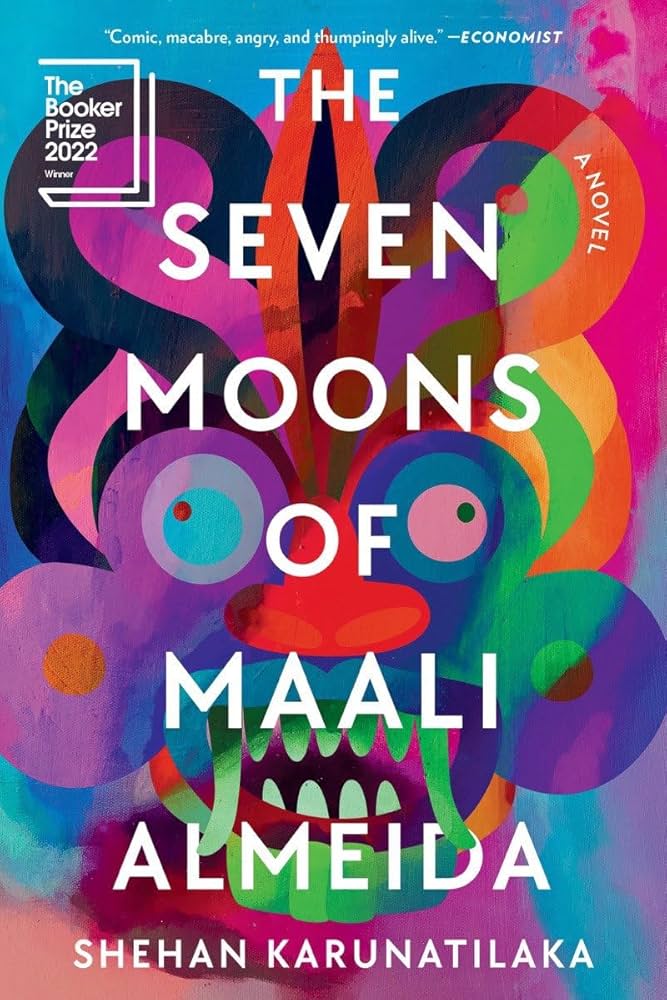
Maybe death isn’t all it’s cracked up to be.
Every soul is allowed seven moons to wander the In Between. To recall past lives. And then, to forget. They want you to forget. Because, when you forget, nothing changes.
This is an extraordinary book. It has been on my To-Be-Read list since 2022, when it won the Booker Prize. It is a book of ideas—profound ideas, comical ideas, terrifying ideas—all wrapped in the guise of a murder mystery that’s also a ghost story that’s also a satire on the human condition. Not surprising, it’s also a challenging read.
It takes place in Colombo in 1989, during the brutal Sri Lankan civil war. This is familiar Joseph Conrad territory (The Heart of Darkness) echoing humanity’s timeless lament, “The horror, the horror.” It’s rarely good guys vs. bad guys, just people doing terrible things to other people, and taking turns being victims.
Maali Almeida is a dead war photographer who can’t remember how he died or who killed him. He had taken photos of massacres, incriminating both sides, and now has seven moons (days) to solve the mystery of his murder and to guide the living to where he hid the photos.
He does this in the Bardo, the in-between state in Tibetan culture between life and death. It is a realm filled with grieving, vengeful, and vindictive spirits. Maali is led, sometimes misled, by guides—the immediately past dead, various spirits and demons. Time here is not linear; it turns back, leaps forward, twists in upon itself.
There’s a lot of humor, although a bleak, sardonic kind of humor: Maali encounters a drag queen who committed suicide. She explains, “I did it because I was sad. That’s what most of us are, you see. But I also did it because I was Buddhist. I thought reincarnation was cheaper than paying for a sex change.”
This book will probably be enjoyed most by those who remember their dreams, because it has the structure, logic, and feel of a dream, at once familiar and bizarre, surreal and revelatory. Like most magic realism, it’s a trip without drugs. Think Salman Rushdie’s Midnight’s Children or the works of Gabriel Garcia Márquez (One Hundred Years of Solitude).
Peppered throughout are tantalizing ideas, on history (“History is people with ships and weapons wiping out those who forgot to invent them”), on the soul and personal identity (“You are not the you that you think you are…You are everything you have thought and done and been and seen.”), on the perpetual and perpetuating religious conflicts (“Everyone should pray to Whoever [i.e., one generic name for the divine] Then no one gets offended.”)
And perhaps the most unsettling idea of all: that death is not final. That the horror doesn’t end with one’s dying.
This time, the pain swipes at your gullet, it chokes you as you remember things you had tried to forget. How scared you were on your first assignment for the army, how hurt you were when your father left, and how disappointed you were to wake up in hospital after overdosing. How much the twenty-nine-year-old you, the eleven-year-old you and the seventeen-year-old you would’ve hated each other. And how the dead you loathes them all.
from The Seven Moons of Maali Almeida
Shehan Karunatilaka
W.W. Norton Company
This review first appeared in The Columbia River Reader (January 15, 2026.) Reprinted with permission.